Pages
- HOME
- ABOUT
- Correspondence & Links
- WILLOWweaving Enterprises
- Leandro Di Lullo WILLOWweaver
- Dunbar Gardens Willows ASA
- Wickery Not Plastic
- Draft Project Plan
- Environment Water in a dry land
- DEcolonise
- QR CODES
- Wickery, Completeness And Perfection
- Aborignal Research Data Base
- Basketry USA
- Bob Mesibov Notes
- WICKER WONDERLUST INTERVIEW
- Australian Baskets
- WICKER WONDERLUST WORKSHOP
- DARK MOFO ningher 2014
Sunday, October 8, 2017
Saturday, October 7, 2017
WILLOWweaving USA
- Dunbar Gardens: Skagit Valley of Washington State, USA.... CLICK HERE
- American Willow Growers Network ... CLICK HERE
- Willow Nursery ... CLICK HERE
- The Branch Ranch ... CLICK HERE
Friday, October 6, 2017
WILLOWweaver: Joe Hogan - Loch na Fooey
Joe Hogan has been making baskets at Loch na Fooey since 1978 and in that time has earned a reputation for making strong, durable baskets of the highest quality.
The colours in these award winning baskets are those of the natural willows which are grown at Loch na Fooey.
Joe also makes indigenous Irish baskets such as the creel. These are available to order and are described in his book, Basketmaking in Ireland, published by Wordwell in 2001.
The main reason for writing this book was to record the techniques used in making Irish traditional baskets, a task that became more urgent as indigenous baskets such as creels and lobster pots began to go out of use. It became apparent that some history of the baskets and their uses would have to be included, because to understand objects requires some knowledge of, and respect for, the people who made and used them. The book is structured so that each chapter contains information that, it is hoped, will appeal to the reader with a general interest in traditional crafts, but most also have a technique section giving details of how to make many of the baskets described.
This technique section is primarily of interest to basketmakers, but the author stresses that because a basket is described as being made in a particular way does not mean that it can be made only in this way. Working within a craft tradition involves having respect for, rather than strict adherence to, the techniques and lore that form that tradition; a tradition that does not change and renew itself becomes stagnant and dies, and it is hoped that this book will not only persuade people to re-evaluate our traditional baskets but also inspire basketmakers to find new uses for some of the techniques described here.
"For me nature is an endless source of inspiration. We are fortunate to live in a wonderful landscape. There are mountains, lakes rivers on our doorstep and areas of wild moorland nearby to delight the eye and nourish the soul. Although we do not have many trees near us the deepening shades of reds and yellows in the moor-land grasses bring their own visual delight. To walk about in such a landscape is to come back recharged with new ideas and renewed energy for creative work. Over a period of time living here I have also developed a strong sense of belonging in the world and this, I feel, is somehow reflected in my work."
Willow Not Plastic AND Fit For Purpose
This image is reported as being gleaned from a flea market. It depicts a WILLOWweaver at work and its speculated that thec 'place' is somewhere in the Netherlands. Interestingly its an image that invokes the memories of those who knew 'Ballards workshop' in their 'young days'.
This images speaks of the 'time-before-plastic' when as likely as not the baskets you bought from a WILLOWweaver was made to order and fit for your purpose.
Elizabeth Pearson saved to 1943 planet earth.Basket making, Mrs Francis Willmott at basket making centre under the auspices of the West Sussex Federation of Women’s Institutes. Aim is to produce 2 million potato baskets – countrywide -for years crop. 1943.
Thursday, October 5, 2017
WILLOWweaving Lessons ONline
This video here follows Mandy Coate's exhibition that ran until April 17 2016.
CLICK HERE https://www.youtube.com/watch?v=o7eVBUJ9vZI
WILLOWweaving generally
Wednesday, October 4, 2017
The Ballard Family Basket Making Enterprise
Any information about the Ballard family and their involvement with basketmaking in Launceston OR information about anyone who had some kind of association with this family business would be welcomed.
Click on an image to enlarge
These baskets were not made by the Ballards ut it seems as if their bussiness made such baskets.
MOTHER BROWN: A 'willower' of a kind
![]() |
| CLICK ON IMAGE TO ENLARGE |
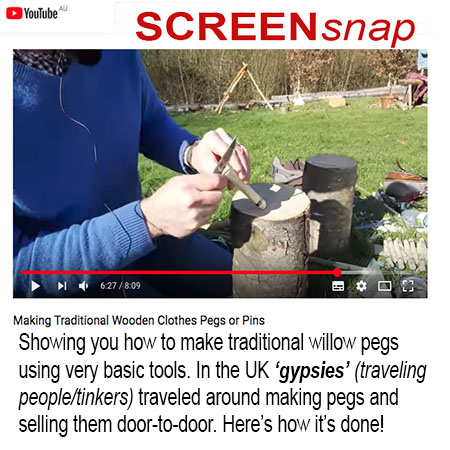
'Mother Brown’ was a ‘WILLOWER” in her own way as it seems she was famous for her 'willow pegs' that sometimes still turn up in Tasmania with various stories attached to them along with memories of Mother Brown. It is just possible that Mother Brown made baskets too. Has anyone heard of this and better still does anyone know of one of her baskets?
A SMALL PIECE OF WOOD
Apparently wooden ‘dolly pegs’ were originally hand made by Gypsies in the UK, who sold them door to door. Sometimes they were carved from hedgerow wood, sometimes they were just a couple of sticks bound together with strips of tin. In Tasmania during the Great Depression a hawker by the name of One-Eyed Mrs Brown followed the same tradition. She sold large clothes pegs made from willow, camping out as she made her way around the State........ http://paulineconolly.com/2017/dolly-pegs-by-the-derwent/
CLICK HERE https://www.youtube.com/watch?v=lpC2Nz-DHOA
WILLOWweaver West Tamar Road Trevallyn/Riverside
![]() |
| This WAS NOT the house as it turns out but it was nearby |
About 15 years I bought some willow baskets from someone who I believe was an Italian retiree(??)working from his house on the West Tamar Hwy. He told me then that he’d stopped making because “the council have taken away my trees ... I cannot get the willow anymore” I bought the 4 baskets he had left and he took down the sign on his front lawn that simply said as I recall “WILLOW BASKETS”. It turns out that his name was Mr. Di Lullo
That sign I’d seen for ages thinking I must go and have a look and when I did it was almost too late.
Cutting to the chase, having told this little story there is some interest in tracking down ‘WILLOWERS’ in Tasmania. This Italian(?) gentleman it would be find out who he was and little bit about his story. He almost probably has passed away BUT he may have family still living in Tasmania and/or on the Tamar somewhere.
Interestingly, there was a similar sign on a house on Westbury Rd. at about the same time. Possibly these signs might be related in some way via the people, the willow they using or the makers ethnic/ origins?? All information and recollections welcomed
PLEASE CONTACT Ray Norman C/- WILLOWweavers Project
It turns out that the maker's name is Mr. Di Lullo
![]() |
| NOT Mr Di Lullo's property |
Subscribe to:
Posts (Atom)