Sunday, January 21, 2018

ONline RESEARCHresource For Wickery

 Click on an image to enlarge

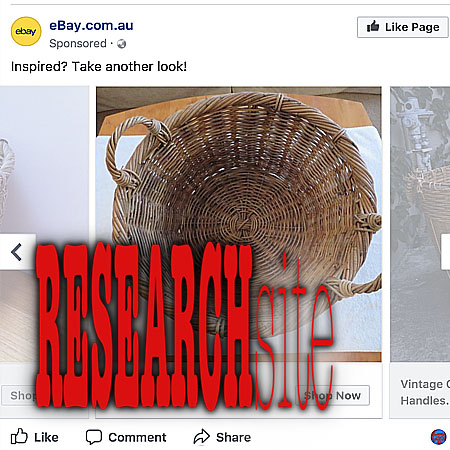
It turns out that ebay along with other 'online auction services' has become a very useful 'research tool'. They are used by a broad cross section of people in the 'developed world' to buy and sell 'things' with stories attached to them. 

These companies use an electronic platform to facilitate millions of transactions every day all of which carry 'cultural cargo' of some kind. Users seeking to purchase items make bids over a specific time period and then the seller determines guidelines such as a minimum bid he or she is willing to accept. Alongside this there're opportunities uncover 'the stories'.

Starting an ebay business is often an accident. Someone decides to make some extra money or clean the house, and she/he places unwanted items from around her home up for auction on ebay GUMtree whatever. 

They are 'electronic storefronts' and online auction market where consumers and researchers can shop for virtually anything they need. These 'storefronts' also tell us quite a bit about how trhings are valued and by whom.

Saturday, January 20, 2018

A ONE HANDLED LAUNDRY BASKET


This looks a lot like Zen Wabi-sabi (侘寂) and a quintessential opportunity for the art of wabi-sabi to really kick in –OR  Kintsukuroi (金繕い, きんつくろい, "golden repair") for that matter. 'The repair' could even be done in RED to denote strength, passion and self sacrifice. The materials of the repair should, like the basket, be able to return to the earth 'gently'. 

AND then there is Ikebana (生け花, "living flowers") is the Japanese art of flower arrangement.

Friday, January 19, 2018

Wickery Not Trash

“Ours is a culture and a time immensely rich in trash as it is in treasures.” 
Ray Bradbury


BIG WICKER

It turns out that in the 'cultural arena' a good place to do SPECULATIVEresearch are the ENTERPRISEsites like eBAY and Gumtree. Such sites are enormous MUSINGplaces under the curatorship of various, and typically anonymous, CITIZENcurators.

Here there is GUMTREEfind from Victoria. It is billed as having had a WICKERlife in a woolshed and on offer to anyone who interested in the narratives that it holds and those that it may carry yet.


Click on an image to enlarge


Discarded 40 years ago but still in daily use


Thursday, January 18, 2018

TENSIONS AND CONTENTION

Willows: friend or foe? 

REFERENCE PROVIDED BY Lionel Morrell _ Heritage Protection Society (Tas)

Willows (Salix L.) were originally introduced to Australia from Europe, Asia, North America and South America for basket making, cricket bat production, stream stabilisation, ornaments and shelter. Planting began soon after European settlement and was most extensive from the 1950s to 1970s to help control stream and gully erosion and for use as windbreaks. During this time, willows became a familiar icon of the Australian landscape.............. During the 1980s and 1990s, the problems with willows became more broadly recognised and a relatively dramatic shift in waterway management occurred. Now, the same trusts and boards that originally advocated their use often conduct extensive willow removal operations (ARMCANZ, ANZECC & FM 2001). The reason for such a profound shift in perspective was the mounting evidence of the impacts that willows cause to both aquatic and riparian environments and their ability to so readily and aggressively colonise new areas.............. Attempts to remove willows from along waterways are still often met with strong community opposition (e.g. Andrews 2006), but there is also growing opposition to leaving them unchecked. In reality, neither the retention nor control of all willows is necessary, feasible or desirable. Instead, effective decisions need to be made about why, when, how and where to manage them. ............. A National Willows Program was established in 2005 in order to guide the strategic management of willows across Australia. At the heart of the program is the desire to build an objective, evidence-based approach that recognises the complex nature of willows and their management. To do this, the National Willows Taskforce has had to manage conflicting views and attempt to interpret contradictory information on almost every aspect of willow management. This paper outlines some of the key outcomes achieved by the National Willows Program to date, the processes used to achieve such outcomes, and how these can be utilized by regions, states and other nations in protecting and improving their waterways for the future  .... http://archive.riversymposium.com/index.php?element=HOLLANDCLIFT

Willows in City Park & Cultural Landscaping


CLICK ON AN IMAGE TO ENLARGE

REFERENCE PROVIDED BY
Lionel Morrell _ Heritage Protection Society (Tas)


THE HORTICULTURAL SOCIETY'S GARDENS, LAUNCESTON. The Gardens of the Launceston Horticultural Society, which are situated at the lower part of Cameron-street, cover an area of nine acres, and have the principal entrance from Cameron-street. passing through the entrance gates the visitor finds himself -in a very pretty shrubbery terminated by a fountain which in the summer season sends forth a shower of sparkling water. From this point walks branch off to the right and left. Taking the path to the right we find that it leads to a portion of the gardens laid out in thei Italian style, consisting of terraced walks and banks covered with flowers and shrubs. One of these walks known as "the Rose Walk," is peculiarly attractive; bordered on each side by a high hedge of China roses, which are in full bloom from early spring till 'autumn and which exhale a delicious, fragrance, this constitutes of a summer evening a delight ful promenade. In this part of the garden, in some secluded spots amongst the shrubs are a few rustic bowers which afford a grateful shade and rest to the tired visitor. Here also from various points good views of the remainder of the gardens which are laid out in the English landscape style are to be observed. The surrounding scenery is also very beautiful; comprising' the valley of the Tamar, the banks of which are dotted here .and there with snug homesteads and cultivated spots; and the lovely valley of the North Esk which is greatly attractive, as possessing a close resemblance to th scenery of some parts of Old England,. Descending from the terraces we come to lawns of, considerable extent bordered with trees and shrubs, -amongst which are placed, a owt se.ata for the accommodation of visitors to' the Gardens. Iero once a year the children belonging to the various Sabbath Schools in the town come to hold their annual festival; and then their laughter as they engage in various sports ringrlight merrily through the summer air, ,and ever and anon a hymn sung by soma hundreds of childish voices, adds the incense of human praise'to the incense which ascends to. the Great Creator from His dther: worki.' In the centro of this lawq Is a:onDseriatory, heated by gas; the gift tif Alexnlder McNaughtan, Esq., and which contains a respectable collection of tropical plants. ' The' conservatory Is surrounded by a small garden in the Dutch style. Keeping to the left the pavillion is reached. This is a rustic building of considerable extent, and is built in the form of a cross, and covered with flowering creepers. It is fitted up for horticultural exhibitions, and is provided with an orchestra for musicians. The Gardens contain productions from almost every quarter of the world, and so genial is the climate of Tasmania that often some gorgeous plant of the tropics literally glowing with beauty may be found surrounded by the less showy yet not less lovely plants of Europe; we have said aot lens' lovely For an are exquisite.. and evsy ptlant Points to the ml.tlly had that formed it. The collection of English trees is rather large, and the trees themselves are very Judicoiualy placed-the delicate foliage of the elm and ash contrasting finely with the masses of 'leaves of the oak and the sombre hues of the holly and yew; and these are again relieved by the vivid green of some weeping willows which droop gracefully at various parts of tile Gardens. There is also a vinery containing upwards of thirty varieties of choice grapes which ripen well in a favorable season. Europe is represented' by the following trees--Ash, oak, elm, sycamore, poplar, laurel, holly, yew, juniper, cypress, ivy, laburnum, pinus, &c. America by agave, gleditechia, magnolia, pinus, rlus, ribes, robinfa, yucca. China and Japan-Ailan. thus, 'ancuba, cydonia, eoonymus, hy. dranges, thuja, wistaria. Capo of Good Hope - Aloe, melianthus, polygalan, podalyria, asophorw, ntherlandla, virgilia, protes. Amongst the products of the Australian Colonies will be found acacia, aroncarla, indigofera, callistemon, pimnele, swainsonta, pultenaea, sterculia, melia; and there are also the following indigenous to Tasmania:-Acacia, banksin, bhellairdura, bursers, casuarina, clematis, croton, eucalyptus, euribla, grevillen, hakes, borve, pomaderris, prostranthera, solaium. New Zealand has the following :--Clian thus, phormlum, veronica, podocarpus. Members of the Society with their families are entitled to admission tothe gardens at all times, parties not members are admitted on the payment of sixpence; and in consideration 'of an annual grant from the Government, the gardens are at the comlIencement of next year to be thrown open gratuitously'to the public for one day in each week. The gardens are under the superintendence of LMr. Wade, who, to a thorough knowledge of his beautiful art, adds the somewhat. rare quality of courtesy to his numerous visitors.

Sunday, January 14, 2018

WICKERY AND PLACE


As ‘plastics’ continually get a bad press communities all over the world are looking around them and trying to figure out what can be done and how it came about that all this contention got to be so difficult – and so full of angst. Commentators very often look back to try and make sense of it all to provide coordinates for a way forward with or without this now ‘ubiquitous material’ in our cultural landscapes. Somehow the multiple narratives layered upon each other and the speed in which they have evolved to make our cultural memories less and less reliable and our aspirations perhaps more and more elusive. 

Somehow, the trust that was once invested in communities' ‘placedness’ has become less secure. Somehow, communities’ cultural realities are being challenged. Somehow, communities’ ‘placedness’ seems less and less tangible as ‘place’ becomes more elastic than ‘our valley’, ‘our street’, our ‘neighbourhood’, our this or that. Yet, unavoidably we find ourselves belonging to, and in,  places – and there are always consequences. In so many ways ‘plastics’ challenge our trust in the things we take from, and bring into, places. We want to trust them to return gently to the earth – one way or another. 

In the end plastics in all their machinations seem to invoke 'global imperatives' and there is more than a little irony to be found in the plastic flotsam and jetsam that is finding its way into enormous ‘rubbish rafts’ far out to sea almost out of sight and almost out of mind. 

Currently, as ‘a material’, plastics seems to touch all of us all the time and all at once – and in ways we can hardly comprehend. Typically, plastics comes to us from far away and rarely if ever by our own hand. The stuff it replaces, and has replaced, and even yet promises to replace, so very often came from very close to hand – from our places, our own cultural landscapes, the places we understand as 'home'. 

The stuff here is the 'nonplastics', the nonminerals, the organic living stuff from which our tools, our clothing, our shelters and ‘furnishings’ can be made – the stuff of wickery. 

‘Wickery’ in its various cultural contexts is an idea loaded with interwoven layer upon layer of narratives, most of which are to do with belonging and ‘placedness’. The wickery that evolves from our  'home places' speaks loudly of them and the cultural imperatives that shape home places – oftentimes subliminally. Ultimately, wickery has become an expansive idea given that in its colonial contexts it carries with it a cargo of ‘elsewhereness’. Simultaneously, it is absorbed into colonised places whilst soaking up local sensibilities and adapting to ‘elsewhere’.

Histories, and the storytelling that go with them, all too often lose their vitality and potency with the passing of time and our preoccupations with newness. As well, wickery has much to say about the here and now albeit that ‘its time’ is most often understood as having past. When examined in some detail the practice of ‘wickery’ and its relativity to place and ‘placedness’ holds lessons worth relearning.  With all this comes the possibility of opening up new social, cultural and technical frontiers.

Ray Norman Jan 2018

Thursday, January 11, 2018

WILLOWweavers QR CODES


Watch out for these QR Codes that are likely to appear in all kinds of places and contexts. They will link you to various aspects of 'the project' as it unfolds over time.

Sunday, January 7, 2018

PLANTS OF KINDRED USEFULNESS

Mike + Doug Starn  Among other things these guys work with bamboo at a somewhat extreme end of the spectrum ... https://www.designboom.com/art/mike-doug-starn-big-bambu/
Since the 1980s, Mike and Doug Starn’s conceptual approach to photography, and use of unorthodox techniques, has broadened notions of what is accepted as a photograph. In a signature manipulation of materials and form, the twin brothers apply innovative printing techniques, and a vast array of materials including transparency film, plexiglass, layered fused glass panels, gilded colored carbon prints, scotch tape, wax and pushpins, to create, and intensify, their metaphorical landscapes. With the theme of light as a central component of their work, the brothers explore the physical and philosophical interconnections between subjects such as leaves, trees, snowflakes, and religious icons, with human memory, perception and thought. Working collaboratively in photography since the age of thirteen, their innovative techniques, and unique combination of sculpture, painting, and video, have defied categorization, and earned them a position of eminence within the history of art.
Born in New Jersey, 1961, Mike and Doug Starn attended The School of The Museum of Fine Arts in Boston. Their work has been widely exhibited throughout the world, and represented in the collections of the Baltimore Museum of Art, Art Institute of Chicago, High Museum of Art, Atlanta, the Los Angeles County Museum of Art, Metropolitan Museum of Art, New York, and the Whitney Museum of American Art, New York, among many others. They live and work in Brooklyn, New York.
LINKS


Enset, the 'false banana'
Tuesday, 03 June 2014
Enset (Ensete ventricosum) is a member of the same botanical family as the banana, but unlike its cousin it’s not grown for its fruit. The main edible parts of the enset plant are the starchy rhizome and pseudostem. Even though the 'false banana' is native to the highlands of eastern and southern Africa, the domesticated types are virtually unknown outside Ethiopia, where it is a staple for nearly 15 million people in the southwestern part of the country. Earlier this year, a team of British and Ethiopian scientists published a draft genome sequence for enset by using the reference sequence for Musa acuminata as a template onto which they aligned their fragments of DNA, an approach similar to the one used to produce a draft genome sequence for Musa balbisiana. For more information on the crop, browse the Musalit records on Ensete ventricosum and downpload the PDF of The "Tree against hunger". 

Banana is amongst those plants considered 'most useful' but largely ignored by the 'the developed world'.


LINKS

Monday, January 1, 2018

WILLOW BARK & BASKETS


Jonathan Ridgeon  Some people NEED this connection in their lives, Jon is one of them. Jon grew up in rural England, adventuring in woodland and working on his bushcraft skills. In 2015 he moved to Norway, seeking out more freedom and to live a simple off-grid self-sufficient lifestyle among the forest and mountains. For the most part, Jon gets what he needs from the land, but he also makes his living as a writer and is the author of three books on the subject of willow weaving. LINK

Processing Willow Bark for Cordage: "Surely one of the best cordage materials; Willow bark is both abundant and relatively easy to process. This article will describe how to strip the bark (in Summer or Winter) and turn it into supple fibre strands ideal for cordage making. There is an accompanying tutorial which shows the techniques you'll need to transform these fibres into cordage or rope. Firstly you need to find and cut down a living shoot/ branch of Willow between 4cm and 10cm thick. Look out for tall relatively straight 'poles' of willow that have as few side branches as possible. Willow will tolerate many growing conditions, but it prefers damp/wet places, so lake sides and river banks are good places to look. A coppiced woodland is a good place to find the straightest wood with few side branches. There are many varieties of Willow, Goat Willow and Crack willow are likely the most common. I have never tried processing Weeping Willow, although this would probably work too." LINK